
Every October since one fast-fingered bus ride in 2017, I have published an “opinions about solar” social media thread. The numbered format looks bad in long-form, but frankly elaboration is for stuff behind paywalls, so I am putting this here too.
If you like these, you might like the second edition of my book, Solar Power Finance Without The Jargon. A 30% discount code WSQ0437 is valid on my publisher’s website until end of November 2026. It’s the book I should have read before trying to get a job in renewable energy. Reviewers describe it as “to the point, important, and taught me a lot” and “surprisingly entertaining, don’t be put off by the title”.
I have put out this thread once a year on X since 2017 and bluesky and mastodon since 2024 (links go to 2025 thread which links to previous threads). So you can see what I got wrong, or at least changed.
This year for the first time I am officially a Clean Power analyst, not a Solar analyst. Alarmingly this means I am now expected to know about batteries, but it also means these Opinions are more varied. Let’s go.
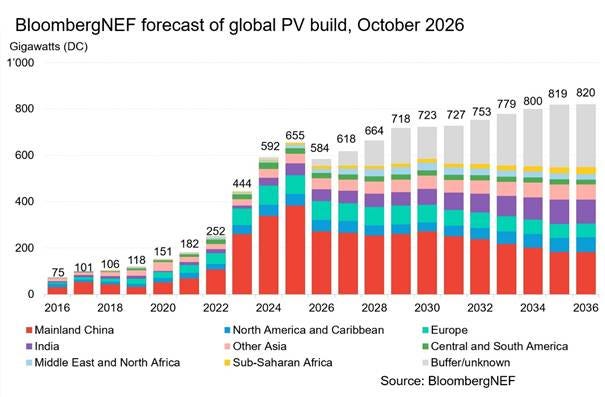
1. It’s the end of the beginning of the age of cheap solar. 2026 is likely to be the first down year for PV build, despite module prices of 11-12 US cents per Watt in normal markets, not substantially up from the lowest levels ever (9 cents in 2025 before a Chinese export tax rebate was cancelled).
2. Solar was about 8.8% of global electricity generation in 2025 (from BNEF’s generation stats, which stick to published figures, ie no selfconsumption or offgrid solar or fossil). It’s much higher in places, eg 18% in Germany (shown). This is causing fewer problems than once feared.

3. Solar is struggling because it’s running into saturation effects in major markets, where there’s already plenty of power in sunny hours, and adding more solar panels generates the most power in the same hours. The power stack in Germany in a sunny week now looks like this:

4. This leads to negative feedback mechanisms: low wholesale power prices in sunny hours, which in forward-looking jurisdictions are passed on to consumers. For example, Australia’s Solar Sharer scheme obliges many utilities to offer a price plan with 3 hours of free power around midday.
5. Solar is still the cheapest source of bulk electricity in many countries, and the quickest to deploy, and now you couldn’t stop it if you wanted to. The limits to PV build in most places that aren’t yet running into saturation effects are grid access and permitting.
6. In a way, it’s reassuring that solar is saturating, as it means solar is actually displacing fossil fuel rather than power demand increasing vertically. But it means the beginning of a new phase: the age of cheap solar and batteries. This too will pass, but it’s just getting started now.
7. Batteries are going to grow like crazy for the next five years or so and BNEF’s forecasting team are being cowards about it. Batteries are still expensive compared with no batteries, but they are easy and quick to build, and can sometimes replace hard-to-organise investments like transmission.
8. The consensus answer to intermittency is now capitalism and batteries. However, batteries reduce peak evening prices much faster than they increase sun-hour prices, so they cannibalize their returns before they increase solar returns. As we already see in Australia (link behind BNEF paywall, sorry).
9. Batteries still do not solve the seasonal problem. A battery of any type that only charges and discharges a few times per year is extremely expensive, even if the capex is low!
10. We oughtta be building more wind, especially in seasonal climates like Europe. Solar will get built anyway, it’s cheap, but wind blows at night and in the winter. We’re going to need something to charge the batteries in winter, especially with rising heatpump use.
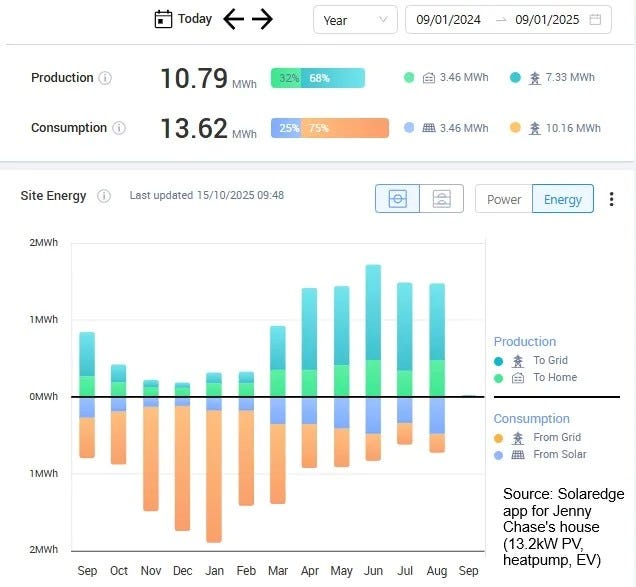
11. How mismatched is European seasonal solar supply and electricity demand? Well, here is the situation for my fully electrified house in Switzerland with 13.2kW of solar, a heatpump and an EV. I would have needed about 122kW of PV to be self-sufficient across December.
12. Sometimes the story is the dog that doesn’t bark in the nighttime. European grids would once have struggled in a 2026-level heatwave, but they had only a few problems and high evening prices. CAISO and Ercot, which also have lots of batteries, had good reliability years despite record loads.
13. Europeans shouldn’t feel guilty about using electricity for airconditioning (or reversible heatpumps), it already mostly comes from the sun, especially if you pre-cool. This is good news for hot countries as well. Heat is deadly.
14. Data center power demand increase is significant but localised, and perhaps not as high as clean power developers would like. BNEF expects data center electricity use to more than triple by 2035, reaching 5.4% of global demand, though 23% in the US PJM market, 18% in Malaysia and 15% in the UK.
15. Data center / Big Tech firms are by far the largest corporate buyers of clean power under power purchase agreements worldwide. They are also signing expensive deals for clean firm power, like nuclear and solar-and-storage, seeking to meet hourly matching targets. Non-paywall report on this here.
16. It is easy to run a baseload power load, like a data center, *mostly* on PV and batteries. Especially where the solar resource is quite constant all year, eg in Saudi Arabia. However, to get the required reliability, you need something else – either gas backup, or some bonkers long-duration storage tech.
17. One good thing about data centers is that they drive some investment into the scale-up of bonkers long-duration storage tech, eg Form Energy’s iron-air batteries (link). They care much less about the cost of power than about speed-to-power.
18. Lithium is going to continue to be the main technology for batteries for the foreseeable future, although China does have some policy support for sodium-ion.
19. After extensive complaints from me, BNEF now defines long-duration storage correctly: not in hours, but as technologies where “the cost and scale of energy capacity (GWh) are largely decoupled from those of power capacity (GW)”.

20. Long-duration storage deployment by BNEF’s definition was just 2GW / 9.6GWh in 2025, mostly in China. The main technologies getting built so far are compressed air and flow vanadium redox.
21. The Hormuz crisis is having relatively little direct effect on solar panel sales, because solar doesn’t usually replace liquid fuel. The crisis is boosting EV sales, particularly in Europe where they reached 36% of car sales in Q2 2026 (China’s figure was 60%, though the car market overall slowed down). This does eventually support solar.
22. It should be all over for the new internal combustion engine car market. The only reason it doesn’t seem to be is that a lot of people don’t seem to realise how times have changed, and still repeat old talking points.
23. Balcony solar: sure, you can put solar on anything. It works at any scale. But the amounts are tiny - this is not really an alternative to building large amounts of rooftop or ground mount solar.
24. “But you can own your own power plant!”.
No normal person wants to own their own power plant. Apart from us weirdoes, most people want to buy affordable, reliable power from the grid and have someone else make the investment and worry about the details.
25. Agrivoltaics: sure, you can put solar on anything. It may even help, eg in this blistering summer a bit of shade would have helped many European crops. But it’s looking for preferential support, because there are reasons farmers currently prefer open, machine-accessible fields.
26. Grazing sheep under solar panels should not qualify for agrivoltaics support. Solar subsidising sheep farming is not particularly an environmental plus. (Some crops do work well with PV, for example shade-tolerant berries, and in some climates, growth isn’t limited by light availability).
27. For 7 years I have been refusing to get excited about perovskites. Still not. Crystalline silicon is honestly pretty great, and perovskites won’t solve the basic problems for solar, which are unrelated to efficiency or price.
28. The US and India are locked into having high-price local solar module markets, due to trade wars.
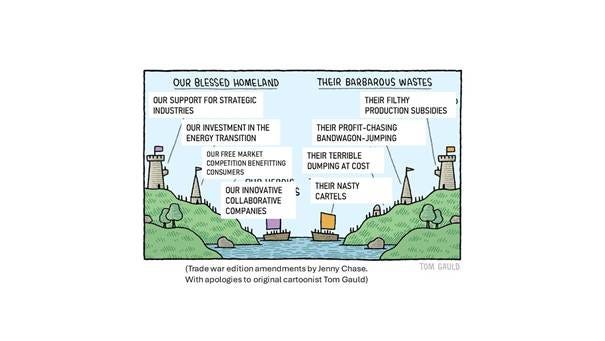
29. As a consequence of trade barriers, US solar module buyers are now paying more than 38 US cents per Watt, for generally worse products than free trade markets are getting for 12 US cents per Watt.
30. The rest of us, if we want to be less dependent on China for solar modules, should buy from southeast Asia, India or Turkey, which will be happy to sell them at much less cost than setting up a domestic industry.
31. The US whack-a-mole approach to tariffs on new solar supply countries has resulted in cell and module factories built in a hurry in Africa, almost on a temporary basis because everyone knows the tariffs will hit them next.
This is not good for developing a skilled workforce or rigorous quality control.
32. A few interesting bellwether markets! Bulgaria, with 2025 peak power demand of 7.4GW, already has 4GW of batteries and a further 2-4GW in the pipeline, for 16GWh total. It is well connected with neighbouring grids and may become a short-term balancing hub.
33. Pakistan: about 25% of generation comes from solar, mostly small systems owned by the user. It has grown due to rising power prices, distrust of the utilities, landlords who see the benefits and provide solar to tenants as patronage, and really good how-to Tiktoks in local languages.
This has stabilised and even reduced Pakistan’s demand for gas and grid power, which puts new stresses on the utilities and the government, which is responsible for capacity payments to China-owned coal plants. I do not know what will happen next.
34. Demand for solar panels to sub-Saharan Africa is rising; it was the destination for 9.4 gigawatts (GW) of Chinese module exports in the first half of 2026, compared with 13.1GW in the whole of 2025. South Africa, Nigeria, Congo, Ghana and Kenya are the largest markets.
35. The Philippines is having an amazing boom – we estimate that it will build 5.6GW of new solar in 2026, compared with 1GW last year. Plus 2.7GWh of batteries in 2026. Maybe the first market where the solar boom comes with batteries from the start.
36. Solar long ago stopped being only for rich countries, and now batteries are the same.
37. Nonetheless, it will be very difficult to reach net zero emissions, and getting rid of the last 10% of fossil fuel will be the hardest. Gas turbine orders hit a record 67GW worldwide in 1H 2026 (paywall).
38. Many of these turbines will run at lower capacity factors than historical gas turbines, and the best sort of fossil fuel plant is one that runs only occasionally. It is possible to have higher fossil capacity but much lower fuel burn, and indeed this makes a lot of economic sense.
39. Even our Net Zero Scenario modelling, to my despair, relies a lot on carbon capture and storage from a residual fragment of gas generation. Net zero is just very hard, but working towards it is better than not working!
40. Decarbonization offers financial savings as well as costs. Even our Economic Transition Scenario, a base case where change is driven by cost analysis and existing policy, has energy import dependence falling substantially for many countries by 2035. Link, no paywall.
41. Achieving a low-carbon transition, for most countries, will not look like winning a war or marching while waving flags. It is the ability to say “no thank you, we do not want what you are selling” to the petrostates, and walking (or cycling, or taking a bus, or driving an EV) away.
The End, for now.
Thanks for sharing. As someone working to scale up an admittedly bonkers long duration energy solution in thermal photovoltaics I found point 17 quite affirming!
The promise that floating solar gives due to opening up wind rich areas of sea could be the answer to winter renewable generation.